
Mold services in Nashville cover everything from a one-room bathroom cleanup to a whole crawl space or a commercial building. Below is every type of job we connect callers with. If you are not sure which fits, call (626) 515-6097 and describe what you see; you do not need to pick a service first.
How do I know which mold service I need?
Start with where the problem is and what caused it. The location usually tells you which kind of specialist fits best:
- Visible growth on walls, ceilings or furniture after a leak or high humidity: mold remediation or black mold removal.
- Musty smell but no visible mold: mold inspection and testing to find the source, or musty odor removal.
- Dark staining on the underside of the roof deck: attic mold removal.
- Damp air, sagging insulation or growth on joists under the house: crawl space mold removal.
- Lower-level walls, carpet or stored items affected: basement mold removal.
- Spots around vents, a smell when the AC runs, or growth on an air handler: HVAC and air duct mold.
- A leak, flood, or appliance failure in the last few days or weeks: water damage mold.
- Shower, tub, ceiling or vanity mold that keeps coming back: bathroom mold removal.
- Offices, restaurants, shops, churches or rental buildings: commercial mold remediation.
What every proper mold job should include
Whatever the service, the federal and state guidance points to the same core steps. The EPA's mold remediation guidance and the Tennessee Department of Health agree on the basics:
- Find and fix the moisture source. Without this, mold comes back. Leaks, condensation, groundwater and humidity are the usual culprits.
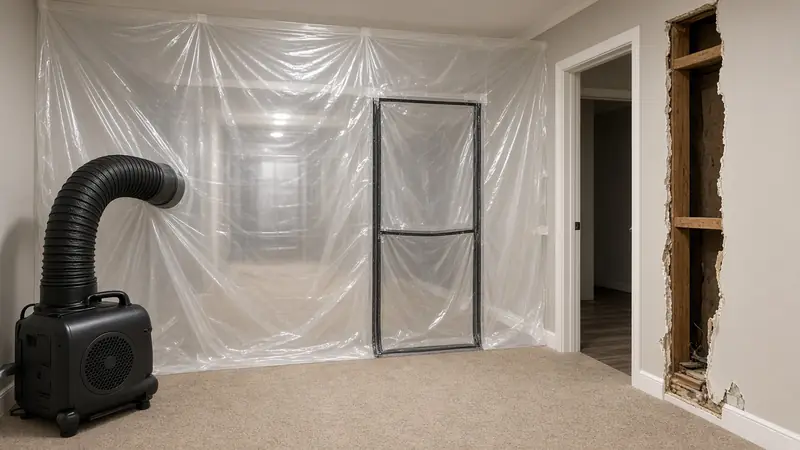
- Contain the work area. For anything beyond a small patch, plastic sheeting and negative air pressure keep spores from spreading to clean rooms.
- Remove porous materials that are moldy. Drywall, insulation, carpet and ceiling tiles with growth are usually cut out and bagged, not sprayed.
- Clean hard surfaces. Wood framing, concrete and metal are cleaned, often with HEPA vacuuming and detergent; heavily damaged wood may be sanded or replaced.
- Dry everything thoroughly. Materials should be dry before anything is closed up.
- Confirm the result. A visual check, moisture readings and, where useful, clearance testing show the job is done.
Why sprays, fogging and ozone are not a fix
Some ads promise to "kill" mold with a fog, a spray or an ozone machine. The EPA notes that dead mold can still cause allergic reactions, so the goal is removal, not just killing. It also says ozone at levels that are safe for people does little to remove indoor contaminants. Bleach is generally not recommended for routine cleanup by the Tennessee Department of Health, and it does not reach into porous materials. If a quote centers on fogging without addressing the moisture source or removing damaged materials, ask more questions.
Nashville conditions that drive mold calls
Middle Tennessee's climate and housing create a few patterns we see again and again:
- Long, humid summers push crawl spaces, attics and basements above 60 percent relative humidity, where Metro Public Health says mold can grow.
- Clay soils over limestone drain slowly, so water collects against foundations after storms.
- Older homes on crawl spaces in neighborhoods like East Nashville, Madison and Inglewood often lack good vapor barriers.
- Newer homes with attic HVAC in suburbs like Spring Hill and Mt. Juliet can drip condensate onto ceilings when drain lines clog.
- Floods and storms, including the May 2010 flood and the March 2020 tornado, left water damage that was not always dried well.
Inspection and testing first, or straight to removal?
If you can see the mold and know why it is there, an inspection to measure the extent and moisture is usually enough to plan the work. Lab testing is most useful when the source is hidden, when you need documentation for a sale, a landlord dispute or an insurance claim, or to confirm clearance after the work. The EPA's guidance on mold testing explains when sampling helps and when it does not. See mold inspection and testing for more.
Residential and commercial
Most of our calls come from homeowners and renters, but the same principles apply to offices, restaurants, schools, churches and apartment buildings. Commercial jobs often add documentation, scheduling around business hours, and coordination with property managers or insurance adjusters. See commercial mold remediation.
How the referral works
Mold Removal Nashville TN is a free phone referral service, not a contractor. When you call, we ask what you see and where you are, then connect you with an independent local mold company that serves your area and handles that kind of job. That company inspects, gives you a written scope and quote, and you decide whether to hire it. You pay the company directly; you pay us nothing. Read more on how it works.
Questions to ask before you hire any mold company
- Where do you think the moisture is coming from, and how will it be fixed?
- What will you remove, what will you clean, and why?
- How will you contain the area and protect the rest of the building?
- Is rebuilding included, or will I need another contractor?
- How will we confirm the job is done: visual check, moisture readings, clearance testing?
- For projects of $25,000 or more: what is your Tennessee contractor license number? Tennessee lists Mold Remediation as specialty classification S-F.
Where we connect callers
We take calls from across Davidson County and nearby cities in Williamson, Rutherford, Sumner and Wilson counties. See all service areas or call with your ZIP code.
Frequently asked questions
Which service should I call about if I am not sure what I have?
Call and describe what you see or smell and where it is. You do not need to know the right service name. Most callers start with an inspection, and the company you are connected with recommends the scope after looking at the area and taking moisture readings.
Do mold companies in Nashville also do repairs?
Some do, some do not. Many remediation companies remove damaged materials and clean the area, then leave rebuilding (new drywall, paint, flooring) to a general contractor. Others offer both. Ask when you get a quote so the scope is clear.
Is mold remediation the same as mold removal?
People use the terms interchangeably. Strictly, remediation means the whole process - finding and fixing the moisture source, containing the area, removing or cleaning affected materials, and confirming the area is clean and dry - while removal can mean just the cleanup step. A good job includes all of it.