
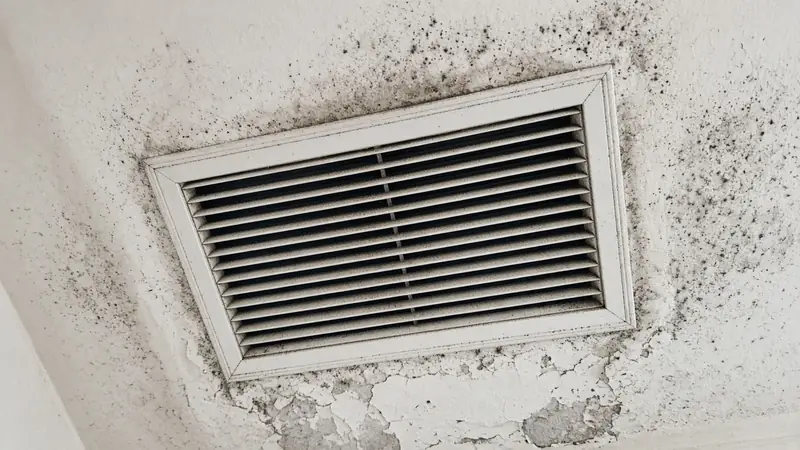
HVAC and air duct mold removal in Nashville starts with finding why the system is wet: sweating ducts, a clogged condensate drain, a dirty coil, or high indoor humidity. Call (626) 515-6097 and we connect you with an independent local mold company, and where needed an HVAC contractor, to inspect the vents, ducts and air handler before cleaning anything.
Where HVAC mold grows
- Supply registers and ceilings around them, from condensation when cold air meets humid room air.
- Evaporator coil and drain pan, which are wet whenever the air conditioner runs.
- Air handler cabinet insulation, if the drain backs up or the cabinet leaks air.
- Ducts in attics and crawl spaces, where uninsulated or poorly sealed metal ducts sweat in humid Nashville summers.
- Flex duct and duct board, which hold moisture and dust and are hard to clean.
- Return grilles and filters, which collect dust and spores.
Why Nashville HVAC systems run into mold
Air conditioning in Middle Tennessee runs hard from late spring into fall, and the air it handles is humid. Many homes have ducts running through vented crawl spaces under older houses in East Nashville and Madison, or through hot attics in newer homes across the suburbs. When a cold duct sits in humid air, it sweats, and the water drips onto insulation and framing. Oversized systems cool the house quickly but shut off before they pull enough moisture out, leaving indoor humidity high. A clogged condensate line can overflow the drain pan, which is often in an attic or closet above finished space.
Metro Public Health notes that mold grows once relative humidity stays above about 60 percent. Keeping indoor humidity in the 30 to 50 percent range the Tennessee Department of Health recommends is one of the best ways to keep the HVAC system and the house dry.
What the EPA says about duct cleaning
The EPA's page Should You Have the Air Ducts in Your Home Cleaned? is worth reading before you pay for duct work. Key points:
- Duct cleaning has not been shown to prevent health problems, and routine cleaning is not recommended for most homes.
- Consider cleaning if there is substantial visible mold inside hard-surface ducts or on other parts of the system, if ducts are infested with vermin, or if they are clogged with dust and debris.
- If mold is present, the cause must be corrected or the mold will return.
- Insulated ducts that have gotten wet or moldy usually cannot be cleaned effectively and should be removed and replaced.
- Be cautious of companies that advertise very low prices or push chemical biocides inside ducts.
How HVAC mold is handled
- Inspection. Vents, returns, filter, air handler, coil, drain pan and accessible ducts. Humidity readings in the house.
- Shut down or isolate the system during any mold removal in the house.
- Clean or replace components. Registers removed and cleaned; coil and drain pan cleaned by an HVAC technician; moldy insulation in the cabinet replaced; contaminated flex duct or duct board replaced; hard ducts cleaned with HEPA vacuum equipment if warranted.
- Fix the moisture. Insulate and seal ducts in attics and crawl spaces, clear the condensate drain and add a safety switch, check refrigerant charge and airflow, consider a properly sized system or a whole-house dehumidifier.
- Address the rest of the house. If the HVAC mold came from a moldy crawl space or attic, that area needs remediation too.
Signs your HVAC system has a mold problem
- Musty smell when the system starts.
- Dark spots on registers or the ceiling around them.
- Water in the drain pan or stains under the air handler.
- Allergy symptoms that seem worse when the system runs.
- Visible growth on the coil or inside the cabinet when the panel is opened.
Who does what
HVAC mold often needs two trades. A mold remediation company handles containment and removal of contaminated building materials; a licensed HVAC contractor services the equipment, replaces duct sections, and fixes airflow and drainage. Tennessee's contractor board licenses mechanical and HVAC work separately from its Mold Remediation (S-F) specialty, so ask each company which part it is licensed to do. When you call, tell us whether you have already had an HVAC technician look at the system.
A quick maintenance checklist
- Replace or clean the filter on the schedule your system needs; more often during heavy cooling months.
- Pour a cup of water into the condensate drain line access each spring to confirm it flows, or have it flushed during service.
- Keep supply and return grilles clear of furniture and dust.
- Have the coil and drain pan inspected during annual maintenance.
- Watch indoor humidity with an inexpensive hygrometer and keep it below about 50 percent.
- If ducts run through the attic or crawl space, look at them once a year for sweating or loose insulation.
HVAC mold calls by area
Sweating crawl-space ducts are common in Madison and Goodlettsville, while attic air handlers with overflowing drain pans turn up in newer homes in Spring Hill and Nolensville. For the source areas, see crawl space mold removal and attic mold removal. If the main symptom is a smell, see musty odor removal or read our guide on musty smells during AC season.
Frequently asked questions
Why is there mold around my air conditioning vents?
When cold supply air meets warm, humid room air at the register, condensation can form on the grille and surrounding ceiling, especially if the duct is poorly insulated, the system is oversized and short-cycles, or indoor humidity is high. Dust on the grille gives mold something to feed on. A technician should check duct insulation, airflow and humidity, not just clean the vent.
Does air duct cleaning remove mold?
Only if the ducts actually have mold and the cause is fixed. The EPA says duct cleaning has not been shown to prevent health problems and should be considered when there is substantial visible mold growth inside ducts or on components. Mold in ducts made of fiberglass duct board or lined with insulation often cannot be cleaned and the section may need replacing.
Can a moldy air handler spread spores through the house?
It can. Mold on the evaporator coil, in the drain pan, or on wet insulation in the air handler cabinet sits right in the airstream. Keeping the condensate drain clear, replacing filters on schedule, and having the coil and pan checked during maintenance helps prevent it.
Should I turn off my HVAC system if I find mold?
If mold is being removed in the house, the system should be shut off or the work area sealed from returns and supplies so spores are not pulled into the ducts. If the mold is inside the system itself, ask an HVAC technician or mold company before running it, and replace the filter.