
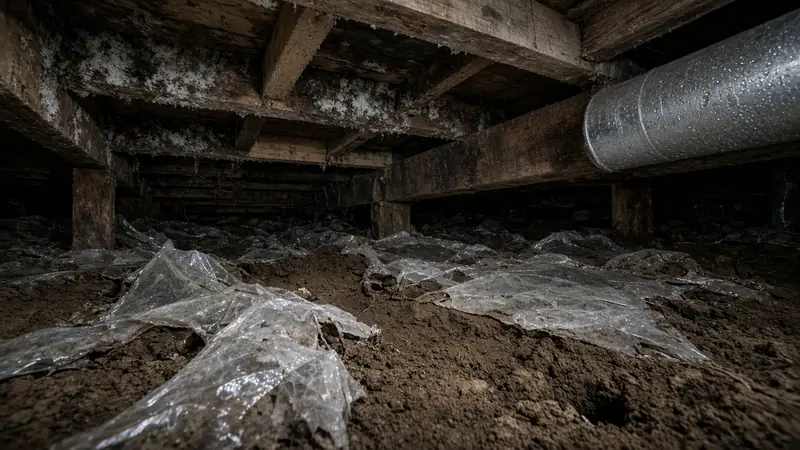
Crawl space mold removal in Nashville means cleaning or treating the moldy wood, and then controlling the moisture so it does not grow back. Call (626) 515-6097 and we connect you with an independent local mold company that inspects the crawl space, measures wood moisture, and quotes both the cleanup and the long-term moisture fix.
Why are Nashville crawl spaces so prone to mold?
Many homes in Nashville's older neighborhoods, from the bungalows near Centennial Park to the streets around Shelby Park and Lockeland Springs, sit on vented crawl spaces. The original idea was that vents would let the space dry. In Middle Tennessee summers, the opposite often happens: warm, humid outdoor air flows in through the vents, meets the cooler wood and soil under the house, and the moisture condenses. Add bare ground, a torn vapor barrier, or a downspout dumping water next to the foundation, and wood stays damp for months.
The Tennessee Department of Health's Healthy Homes guidance lists "damp soil or standing water in crawl spaces" among the signs of a moisture problem, and recommends vapor barriers and sealants for basements and crawl spaces.
Signs of crawl space mold
- White, gray or black fuzzy growth on joists, beams and the underside of the subfloor.
- Wood moisture readings consistently above the high teens (percent).
- Condensation on ductwork or pipes; dripping insulation.
- Sagging or torn fiberglass batts between joists.
- Standing water or muddy soil after rain.
- Musty smells in the house, especially near floor registers.
- Soft spots in floors above, or cupping hardwood.
How crawl space mold is removed
- Assessment. The company crawls the whole space, measures wood moisture and humidity, checks drainage, plumbing and ducts, and documents the growth with photos.
- Debris and insulation removal. Old, wet or moldy batts and debris are bagged and removed.
- Cleaning the wood. Methods include HEPA vacuuming, scrubbing or wire brushing, sanding, and in some cases dry-ice or soda blasting. An EPA-registered antimicrobial may be applied after cleaning.
- Drying. A dehumidifier brings wood moisture down before anything is sealed.
- Moisture control. The long-term fix, below.
Long-term moisture control options
Ask for these as separate line items so you can compare:
- Drainage outside. Downspout extensions and grading that slopes away from the house are the cheapest fixes and often the most important.
- Vapor barrier. A heavier polyethylene liner, overlapped and taped at seams, run up the walls and sealed.
- Encapsulation. Vents and the access door sealed, walls and ground fully lined, and the space dried with a dehumidifier or a small supply of conditioned air. Building codes allow conditioned crawl spaces when designed properly.
- Interior drainage and sump. For crawl spaces that take in water, a perimeter drain and sump pump.
- Plumbing and duct repairs. Fixing leaks and sealing and insulating ducts that sweat.
If the crawl space floods during heavy rain, check your FEMA flood zone and insurance options through FloodSmart, and remember that Metro Water Services' stormwater program handles drainage issues in public ways.
Nashville flood history and crawl spaces
The May 2010 flood put water into crawl spaces across Davidson and Williamson counties, from the Harpeth River in Bellevue to Mill Creek in Antioch. Some of those homes were cleaned and dried well. Others were pumped out and closed up with wet soil and soaked insulation left behind. When a homeowner tells us the floors have smelled musty "ever since the flood," the crawl space is the first place to look.
Questions to ask the company
- What are the wood moisture readings now, and what will they be after?
- Will you remove the old insulation, and will you replace it?
- What vapor barrier thickness and sealing method do you use?
- Is a dehumidifier included, and who maintains it?
- What exterior drainage changes do you recommend?
Crawl space calls around the metro
Crawl space mold calls are common in East Nashville, Madison and Goodlettsville, where many homes predate modern vapor barriers, and in low-lying parts of Bellevue near the Harpeth. If the smell has moved into the house, see musty odor removal; if ducts run through the crawl space, see HVAC and air duct mold. For more background, read Why crawl spaces in Nashville grow mold.
Frequently asked questions
Why does my Nashville crawl space have mold?
Most crawl space mold comes from humid outdoor air entering through foundation vents in summer and condensing on cooler wood, from ground moisture rising through bare or torn plastic, from poor drainage that lets rain water pool, and from plumbing or duct leaks. Middle Tennessee's long humid season makes vented crawl spaces especially prone to it.
Is crawl space encapsulation worth it?
For many damp crawl spaces, yes. Sealing vents, covering the ground and walls with a heavy liner, and drying the space with a dehumidifier or conditioned air can keep wood at safe moisture levels. It costs more than a basic vapor barrier and needs a working drainage plan, so ask for both options in writing.
Can crawl space mold make my house smell?
Yes. Air moves up from the crawl space into the living space through gaps around plumbing, wiring and ducts, and through the floor itself. A musty smell that is strongest in lower rooms, closets or near floor registers often points to the crawl space.
Do I need a vapor barrier if I already have one?
Look at its condition. Thin plastic that is torn, pulled back by plumbers, or missing along the walls lets ground moisture through. A heavier barrier that is overlapped and sealed at seams and walls works much better. The inspection should note the barrier's condition and the soil moisture under it.