
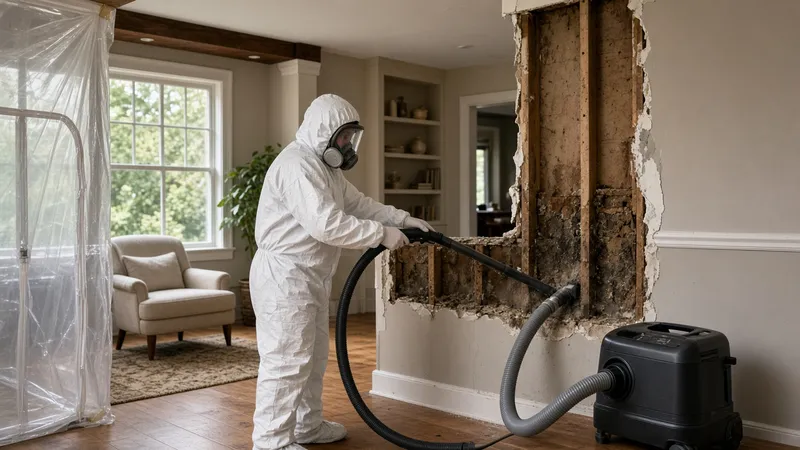
Mold removal in Nashville starts with finding the water. Call (626) 515-6097, describe what you see or smell, and give your ZIP code. We connect you with an independent local mold company that inspects the area, finds the moisture source, contains the work zone, removes or cleans the affected materials, and gives you a written quote before anything is torn out.
Mold Removal Nashville TN is a phone-only referral service for Nashville, Davidson County and the cities around it. There is no form and no waiting for an email. Your call is connected to a company that handles your kind of job, from a moldy attic in Bellevue to a damp crawl space in East Nashville.
Why does mold grow so easily in Nashville homes?
Middle Tennessee has long, humid summers and plenty of rain, and mold needs only moisture, a food source like drywall or wood, and time. Metro Public Health says mold can grow once indoor relative humidity stays above about 60 percent. In a Nashville August, an attic, a basement or a crawl space can sit above that for weeks.
Water also has history here. During the May 2010 flood, the National Weather Service recorded 13.57 inches of rain at Nashville International Airport in two days, and the Cumberland River crested at 52.55 feet downtown. Homes along Mill Creek, the Harpeth River and Richland Creek took in water, and some still have hidden damage from that year or from smaller floods since. When we hear "the smell came back after a heavy rain," the cause is usually a moisture path that was never fully fixed.
Housing age matters too. Many homes near Centennial Park and in East Nashville sit on crawl spaces with thin or missing vapor barriers, while newer, tighter builds in Antioch and the suburbs trap shower and cooking moisture fast.
Mold services we can connect you with
The jobs we route most often:
- Mold remediation: containment, HEPA filtration, removal and cleaning.
- Mold inspection and testing: finding hidden moisture, and sampling when it helps.
- Black mold removal: dark growth on drywall after long leaks.
- Attic mold removal: stained roof sheathing from poor venting.
- Crawl space mold removal: joists, subfloor and vapor barriers.
- Basement mold removal: wet walls, carpet or framing.
- Bathroom mold removal: showers, ceilings and leaking tubs.
- HVAC and air duct mold: vents, air handlers and sweating ducts.
- Water damage and mold: leaks, burst pipes and floods.
- Commercial mold remediation: offices, rentals and retail.
- Musty odor removal: tracing a smell you cannot see.
How the call works
- You call. Tell us what you see or smell, where it is in the building, how long it has been there, and your ZIP code.
- We connect you. We route the call to an independent local mold company that serves your address and handles that kind of job.
- They inspect. The company looks at the area, checks moisture, and explains what is causing the growth.
- You get a written scope and quote. Nothing is removed until you approve it, and you are free to get other quotes.
Details: how it works.
What a proper mold remediation looks like
A good Nashville mold company follows the same basic order the EPA describes in its Brief Guide to Mold, Moisture and Your Home: fix the water problem, then clean or remove the mold.
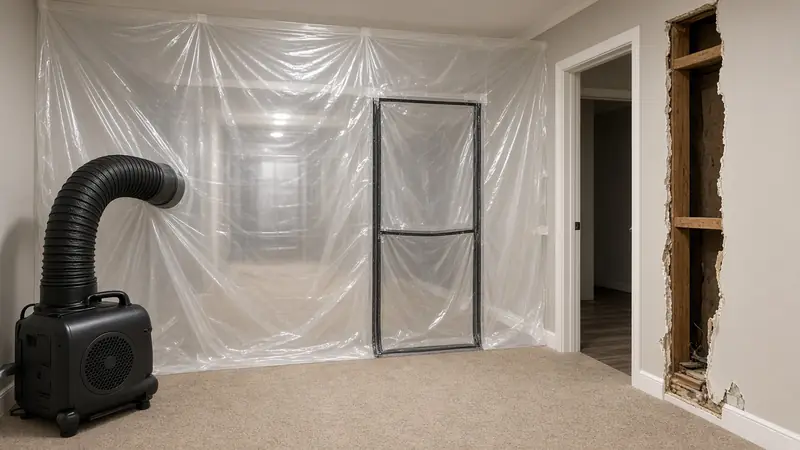
On a typical job the company sets up plastic containment so spores do not spread to clean rooms, runs HEPA air filtration, removes porous materials that are moldy (drywall, insulation, carpet pad, ceiling tiles), HEPA-vacuums and cleans framing and other hard surfaces, and dries everything before it is closed back up. The Tennessee Department of Health's Healthy Homes guidance makes the same point: painting or caulking over mold does not fix it, and porous materials should be replaced.
Be wary of anyone who sprays and leaves without fixing the moisture. If the water stays, the mold comes back.
Testing, licensing and renter questions
The state health department, the CDC and the EPA do not recommend routine mold testing, because there is no official "safe" level and visible mold should be removed either way. Testing is useful when the source is hidden, when you need clearance documentation after remediation, or for a sale or a dispute. Our mold testing guide explains when sampling is worth paying for.
Tennessee's contractor board lists Mold Remediation as specialty classification S-F, and a state license is required for projects of $25,000 or more. Ask any company for its license number and insurance, and look it up before signing.
Renters in Davidson County can report conditions that make a unit unsafe or unsanitary to the Metro Codes Property Standards Division through hubNashville. Our guide to mold in Nashville rentals walks through the steps.
Areas we take calls from
We take calls from all of Metro Nashville, from homes near Shelby Bottoms and Lockeland Springs to the hills around Radnor Lake, and from the suburbs. Some of the most common:
- East Nashville, Antioch, Bellevue, Hermitage and Madison
- Brentwood, Franklin, Spring Hill and Nolensville in Williamson and Maury counties
- Murfreesboro and Smyrna in Rutherford County
- Hendersonville, Gallatin and Goodlettsville along Old Hickory Lake
- Mt. Juliet and Lebanon in Wilson County
See every page on our service areas list.
Before you call: three things to do today
- Stop the water if you can. Shut off a leaking supply line, tarp a roof leak, or run a dehumidifier in a damp basement.
- Do not disturb large growth. Scrubbing or tearing out moldy drywall without containment can spread spores through the house and the HVAC system.
- Take photos. They help the company come prepared and help with any insurance claim.
Our blog covers crawl spaces, black mold myths, insurance and mold after a flood.
Frequently asked questions
How much does mold removal cost in Nashville?
There is no honest flat price. Cost depends on how much material is affected, whether it sits in an attic, crawl space or finished wall, how much containment is needed, and whether the moisture source needs repair. The local company inspects and gives you a written scope and quote before work starts, and you are free to say no.
Do I need to test for mold before removal?
Usually not. The Tennessee Department of Health, CDC and EPA say testing is generally not needed when you can see or smell mold, because every mold should be removed and the moisture fixed. Testing helps when the source is hidden, after remediation to confirm clearance, or for real estate and legal records.
Can I clean mold myself?
Small patches, roughly under 10 square feet by EPA guidance, on hard surfaces can usually be cleaned with detergent and water while wearing gloves, goggles and an N95. Larger areas, mold inside walls or HVAC systems, growth after sewage or flood water, or anyone in the home with asthma or a weak immune system are reasons to call a professional.
Does Tennessee license mold remediation companies?
Tennessee's Board for Licensing Contractors has a Mold Remediation specialty classification (S-F). A state contractor license is required before bidding or contracting on projects of $25,000 or more. For any size of job, ask the company for its license number and insurance and look the license up on the state's search site.
Which areas around Nashville do you cover?
Calls come from all of Davidson County, including East Nashville, Antioch, Bellevue, Hermitage and Madison, and from nearby cities such as Brentwood, Franklin, Murfreesboro, Hendersonville, Gallatin, Mt. Juliet, Smyrna, Lebanon, Spring Hill, Goodlettsville and Nolensville. Tell us your ZIP code and we will tell you whether we can connect you.
Who will actually do the work?
An independent, locally operating mold inspection or remediation company. We are a free referral line, not a contractor. The company you are connected with sets its own price, schedule and terms, and you deal with it directly. Ask about its license, insurance, containment method and whether it offers or recommends clearance testing.