
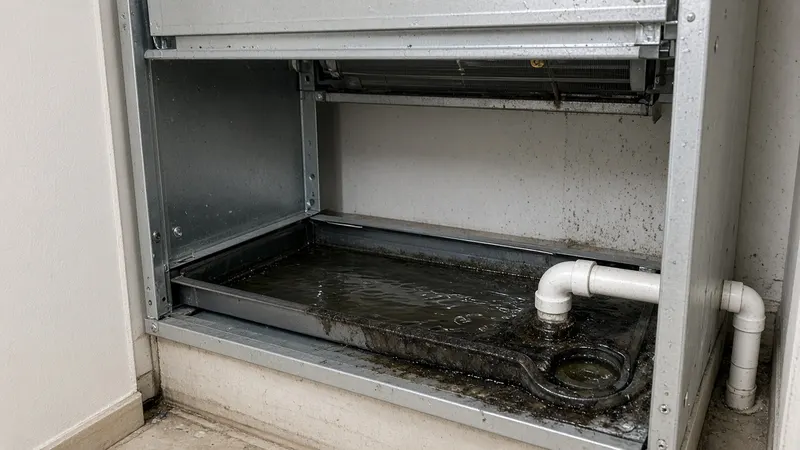
That damp, earthy smell when the air conditioner starts is one of the most common mold calls in Middle Tennessee summers. The good news: the cause is usually findable and fixable.
How AC systems create moisture
Your air conditioner cools air by passing it over a cold coil. Moisture from the air condenses on the coil, drips into a drain pan, and leaves through a condensate line. On a humid Nashville day, a typical system removes gallons of water. When that water does not drain properly, or when surfaces stay wet, mold grows right in the air stream.
Common sources of the smell
Clogged condensate line or dirty drain pan. Algae and sludge clog the line; water sits in the pan and grows slime and mold. Attic systems may overflow onto ceilings.
Dirty evaporator coil. Dust on a wet coil is food for mold. The smell blows out every time the fan starts.
Sweating ducts. Ducts in crawl spaces and attics can collect condensation on the outside, wetting insulation and nearby wood. Inside, damp ductwork can grow mold.
Crawl space air. Leaky return ducts in a crawl space pull damp, musty air directly into the system. See crawl space mold and Nashville humidity.
High indoor humidity. If the system is oversized or the fan runs constantly, moisture can re-evaporate from the coil back into the house.
How to trace it
- Check the condensate line where it exits the house. Is water dripping when the AC runs? If not, it may be clogged.
- Look at the drain pan if you can safely open the air handler access panel. Standing water or slime is a sign.
- Change the filter. A clogged filter restricts airflow and can make coils colder and wetter.
- Check indoor humidity with a hygrometer. The Tennessee Department of Health recommends 30 to 50 percent.
- Sniff the supply vents in different rooms. A smell in just one room may point to a duct problem; everywhere suggests the air handler.
- Look under the house if you have a crawl space.
What fixes it
- Flushing and clearing the condensate line, and adding a float switch.
- Cleaning the coil and drain pan.
- Sealing and insulating ducts in crawl spaces and attics.
- Fixing crawl space moisture.
- Adjusting fan settings so the fan does not run constantly in summer.
- Having an HVAC contractor check system sizing and refrigerant charge.
When there is visible mold in the air handler or ducts, cleanup needs care so spores are not spread through the house. See HVAC and air duct mold and musty odor removal.
Seasonal timing in Nashville
The smell often shows up in late spring, the first warm, humid days when the AC starts running hard after months of heating. Water that sat in a pan or line over the winter, plus a coil that collected dust, gets wet again all at once. A spring tune-up before the first heat wave, with the coil, pan and condensate line cleaned, prevents many of these calls.
What about duct cleaning?
The EPA's guidance on whether you should have your air ducts cleaned says cleaning may be warranted when there is substantial visible mold growth inside ducts or on other system components. It also warns that if the moisture problem is not corrected, mold will likely return.
Sprays and foggers
Spraying a fragrance or biocide into vents may mask the smell for a while but does not fix the cause. Some products are not approved for use in HVAC systems. Ask what is being applied and why.
When it is time to call
If the smell persists after a filter change and condensate line flush, if you can see growth in the air handler, or if ceilings near attic equipment are stained, it is time for an inspection. Read attic mold causes if your system is in the attic, and do you need mold testing before paying for sampling.
Call (626) 515-6097 to be connected with a local company that handles HVAC-related mold.
Frequently asked questions
Should I get my air ducts cleaned?
The EPA says duct cleaning has not been shown to prevent health problems, but it recommends considering it when there is substantial visible mold growth inside ducts or on HVAC components, among other reasons. If there is mold, the moisture cause must also be fixed or it will return.
Can an oversized air conditioner cause mold?
It can contribute. An oversized system cools the house quickly and shuts off before it removes much moisture, leaving indoor humidity high. In Nashville's humid summers, that can feed mold on cool surfaces and in the system. An HVAC contractor can check sizing and settings.