
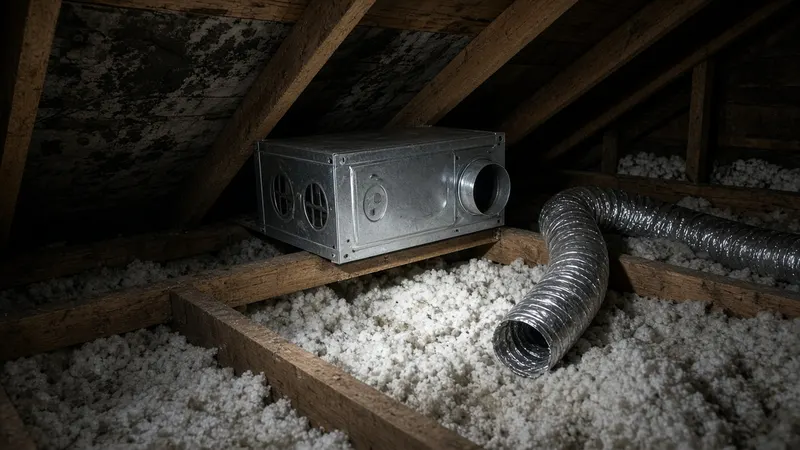
Attic mold usually goes unnoticed for years. Nobody spends time in the attic, and the first sign is often a home inspector's report or a musty smell from an upstairs closet. In Nashville, a few causes account for most cases.
Cause 1: Bath fans and dryer vents that end in the attic
This is the most common cause we hear about, especially in newer homes. A bath fan should send humid air outside through a roof or wall cap. When the duct is disconnected, crushed, or simply ends in the attic, every shower pumps warm, wet air onto the cold underside of the roof. In winter, that moisture condenses and feeds mold. Dryer vents and kitchen hoods that end in the attic do the same.
Cause 2: Blocked soffit vents and poor ventilation
Attics are designed to breathe, usually in at the soffits and out at the ridge. When insulation is blown over the soffit vents, or ridge vents are missing or blocked, moist air gets trapped. Mold often shows up first on the north side of the roof, which stays cooler and dries more slowly.
Cause 3: Warm air leaking up from the house
Gaps around recessed lights, attic hatches, plumbing stacks, wiring holes and duct boots let warm, humid household air rise into the attic. Air sealing these gaps, then adding insulation, reduces moisture and lowers energy bills.
Cause 4: Roof and flashing leaks
Leaks around chimneys, skylights, plumbing vents, valleys and old shingles can wet sheathing and insulation. Leaks often show up as localized staining and soft spots, unlike the widespread staining from ventilation problems.
Cause 5: HVAC in the attic
Many Nashville-area homes have air handlers in the attic. A clogged condensate line or rusted drain pan can drip water onto ceiling drywall and insulation. Uninsulated or leaky ducts can sweat in summer. See musty smells during AC season.
Signs of attic mold
- Dark gray or black staining on the underside of the roof sheathing, often in a pattern between rafters.
- Frost on nails or sheathing in winter, or rusty nail tips.
- Damp or compressed insulation.
- A musty smell in upstairs rooms or closets.
- Ceiling stains on the top floor.
How attic mold gets fixed
- Fix the moisture source: reroute bath fans to the exterior, clear soffits, add or repair ventilation, seal air leaks, or repair the roof.
- Remove or clean the growth on sheathing and rafters, typically with HEPA vacuuming and scrubbing, sanding or other abrasive methods.
- Replace wet or moldy insulation where needed.
- Confirm the area is dry and ventilation works.
See attic mold removal for more detail. If attic HVAC is involved, see HVAC and air duct mold.
Why Nashville attics are especially prone
Middle Tennessee winters bring many nights near or below freezing, and the roof deck gets cold. Warm, moist air from the house meets that cold wood and condenses. Then summer brings heat and humidity that can keep damp insulation from drying. Add mature shade trees that keep roofs wet after rain and fill gutters, and many older neighborhoods have the perfect conditions for slow attic mold.
Coatings and sprays
Some companies apply a colored coating after cleaning. A coating does not replace fixing the moisture source or removing the growth. Ask what the coating is for and what happens if the moisture returns.
Buying a home with attic mold
Attic mold is a common home inspection finding in Middle Tennessee. Ask the inspector what is causing it, and get a written quote that includes fixing the cause. For more on testing, see do you need mold testing.
A quick self-check
Once a year, take a flashlight into the attic. Look at the underside of the roof deck, check that bath fan ducts are connected and lead outside, make sure insulation is not blocking the soffits, and look for wet spots. The EPA's guide to mold and moisture has general moisture-control tips.
Need someone to look? Call (626) 515-6097 to be connected with a local mold company.
Frequently asked questions
Is attic mold dangerous to the people living below?
Attic air does mix with living-space air through gaps around lights, the attic hatch and ducts, so attic mold can affect indoor air, especially if HVAC ducts or equipment are in the attic. The bigger risk is to the roof deck itself over time. Fix the cause and remove the growth.
Do I need a new roof if my attic has mold?
Usually not. Most attic mold is surface growth on sheathing that can be cleaned once the moisture cause is fixed. Replacement is needed only where the wood is rotted or soft. An inspection will tell you.